

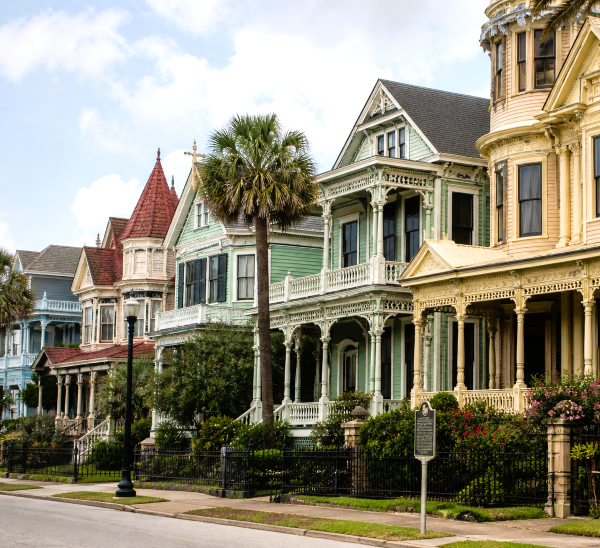
The first time most buyers step inside a historic home on Galveston Island, something shifts. It’s the ceilings. Or the original pine floors. Or the transoms above the doorways, or the staircase that couldn’t possibly still be this beautiful after a hundred and thirty years. Whatever it is, they walk out onto the porch and look at me and say some version of: I didn’t know houses were still made like this.
They weren’t made like this. They were built like this, by craftsmen working at a scale of craft that isn’t economically practical anymore, and these particular houses happened to survive everything the Gulf of Mexico and a century of Texas weather could throw at them.
I find that people either love Galveston’s historic homes immediately and completely, or they don’t quite get it. If you’re in the first group — if you already feel it — then this post is for you. Because there are things to understand before you make an offer on one of these properties, and I’d rather you know them from me than discover them after closing.
The Historic Districts: What They Are and Why They Matter
Galveston has several designated historic districts, with the East End Historic District and the Silk Stocking Historic District being the most well-known. When you buy inside one of these districts, your property is subject to review by the Galveston Historical Foundation and the city’s Historic Preservation Committee if you make changes to the exterior.
Interior renovations are generally your business. But changes to the facade, the roof, the windows, the porch — anything visible from the street — typically require approval. That means submitting plans, waiting for review, and using materials and methods that are consistent with the period.
Some buyers hear this and feel restricted. I understand that reaction. But here’s my honest take after years of helping people buy and sell in these neighborhoods: the historic district rules are a large part of why these streets look the way they do. They’re what kept the neighborhood from being converted piecemeal into something generic. The rules protect your investment as much as they govern your renovation.
What I’d suggest: before you make an offer on a historic property, spend twenty minutes reviewing the city’s design guidelines. And if you’re planning significant exterior work, call me — I can help you understand what’s likely to be straightforward and what might need more planning.
The Insurance Conversation You Need to Have Early
This is where I want you to pay close attention, because this is the piece that surprises buyers most.
Historic homes in Galveston require careful insurance planning — more so than newer construction elsewhere. There are two things working together here: age and location.
The age of the home affects replacement cost calculations. An insurer replacing a 130-year-old home with original heart pine floors, plaster walls, and custom millwork is covering something that would be extraordinarily expensive to replicate authentically. Make sure your policy reflects the actual replacement cost of what you’re buying, not a generic square-footage estimate.
The location adds flood zone considerations that any Galveston buyer needs to understand. Many historic homes were built before modern flood maps, and some sit in zones that require separate flood insurance through the National Flood Insurance Program. The premiums vary considerably depending on the property’s elevation and flood zone designation.
I’m not an insurance agent, and I won’t pretend to be. What I’ll tell you is this: get an insurance conversation going early — before you’re under contract, ideally before you’ve written an offer. I can refer you to agents who specialize in historic and coastal properties in Galveston, and knowing your insurance costs in advance makes your financial picture much clearer.
What “Original” Actually Means in a Galveston Victorian
Here’s something I’ve learned from working with these homes over the years: “original” is a word buyers use to mean a dozen different things.
Original floors are usually a good thing — old-growth heart pine is genuinely more durable than most modern flooring and beautifully refinishes. Original windows are charming and often a historic district priority, but they typically require weatherstripping, rope and pulley repair, or custom storm window additions to perform well energetically. Original plumbing and electrical are almost always on the list for improvement.
A good inspection on a historic home takes longer than a standard inspection. It should. You’re looking at a building with a long history, and that history is visible in layers — previous repairs, previous additions, previous decisions made by owners who had different priorities than you do. I strongly recommend inspectors who have experience with pre-1930s construction specifically. Some of what they find is cause for concern. Much of it is just old houses being old houses.
The goal is to know what you’re getting into. In my experience, buyers who go in with clear eyes about the maintenance expectations tend to love these homes for decades. Buyers who were surprised by the reality of ownership find it harder.
The Part That Makes It Worth It
I know this post has covered a lot of caution. So let me close with the part I believe.
There is no other neighborhood on the Texas Gulf Coast that looks like the East End of Galveston Island in the evening light. There is no other city in Texas where you can walk down a street and feel the actual texture of the 1880s — not reconstructed, not restored to a theme-park standard, but lived-in and present and continuous. These homes have been through storms that leveled other cities. They’re still standing because they were built well and because the people who owned them cared.
When you buy a historic home in Galveston, you’re not just buying a property. You’re taking on a piece of the island’s story. You’re joining a neighborhood where your neighbors have, in many cases, been restoring and maintaining these houses for decades. It’s a community with an unusual amount of shared investment in what the place looks like and what it means.
I think that’s worth the insurance conversation. Worth the historic district review. Worth the longer inspection.
If you’re drawn to it, I’d love to walk a few of these streets with you and show you what I see. Reach out — no pressure, just a conversation and a walk.