

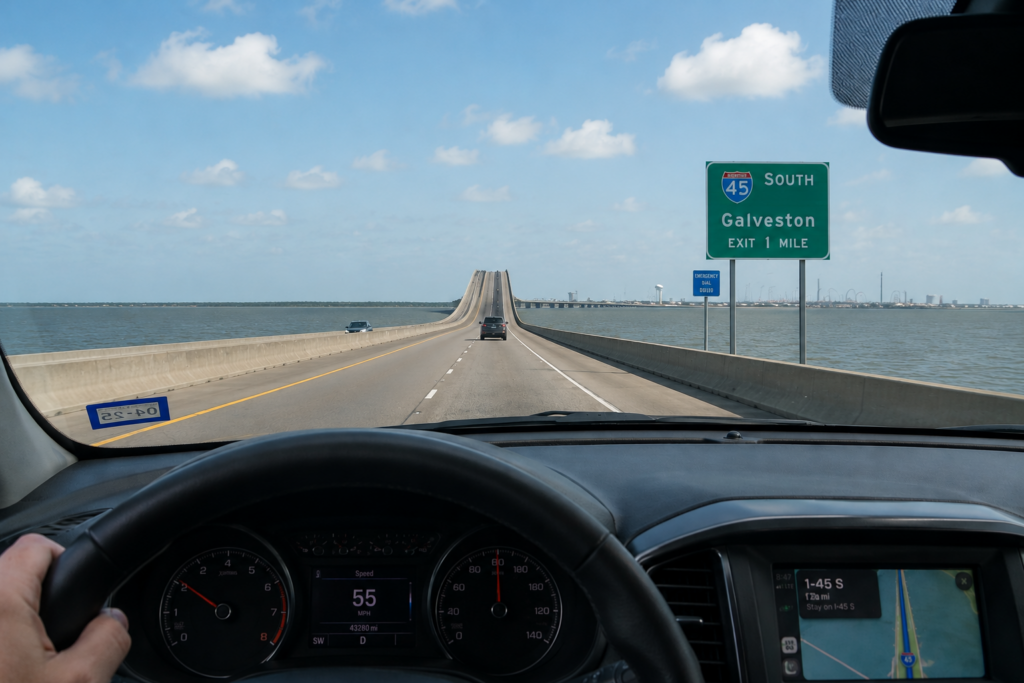
Most of the buyers I talk to don’t live on the island. They live in Houston — in The Heights, in Sugar Land, out in Katy or The Woodlands — and they’ve spent enough Friday evenings on I-45 heading south to start wondering what it would be like to keep going. Not just for the weekend. For good, eventually. Or at least for a place that’s theirs whenever they want it.
If that’s where you are, the first thing I’d tell you is that buying a Galveston home from Houston is a different decision than buying one if you already live here. Not harder. Just different. And the difference comes down almost entirely to the drive.
The Drive Is the Whole Decision
It’s about an hour from most of Houston to most of Galveston, traffic permitting. The causeway is one of the only ways on and off the island, so a wreck or a summer Saturday can stretch that out. I’d tell any Houston buyer to make the drive a few times at the hours you’d actually be making it — Friday at six, Sunday afternoon coming back — before you fall for a specific house.
That hour shapes everything. It’s close enough that a weekend here is genuinely easy. It’s far enough that you won’t be running back for a forgotten phone charger. Most people land somewhere in the middle: close enough to use the place often, far enough that it feels like leaving real life behind for a couple of days. That gap is exactly what people are buying, even when they don’t say it that way.
You’re Buying a Weekend, Not Just a House
When you live an hour away, you’re not really buying a house. You’re buying how you’ll spend your Saturdays.
So I ask Houston buyers questions that don’t come up as much with local buyers. Do you want to walk to the water, or is a short drive fine? Are you bringing people down — kids, friends, family from out of state — or is this your quiet place? Do you see yourself here mostly in summer, or is the off-season part of the appeal? The honest answers point toward very different houses.
I’ve watched buyers get talked into more house than they’ll use because it photographed well. A home you visit forty weekends a year doesn’t need to do everything. It needs to do the few things you actually came down for. That’s a better filter than square footage.
Which Parts of the Island Fit a Houston Buyer
There’s no single right neighborhood, but the drive does sort things out.
The West End suits the weekend crowd. It’s quieter, you get more space and more water, and it’s the part of the island most people picture when they imagine a beach place. The trade-off is that it’s farthest from the causeway, so you’re adding a little more drive on each end and you’re farther from groceries and everyday errands.
The Historic East End is for buyers who like Artwalk, Mardi Gras, Dickens on the Strand and other annual festivals. If coffee with friends at a corner cafe, or shopping on The Strand, or a performance at the Grand 1894 Opera House is your get-away, let’s explore the East End for a Victorian beauty or stylish loft.
Midtown tends to fit buyers who think they’ll go full-time someday. They’re more residential, closer to the practical side of island life, and they hold a year-round rhythm the beachfront blocks don’t. If Galveston is a someday-home and not just a getaway, I’d have you look here.
The Seawall condos work for the lock-and-leave buyer. You close the door, drive back to Houston, and you’re not thinking about the yard or the exterior. For someone splitting time between two places, that simplicity is worth a lot more than it looks like on paper.
None of these is better than the others. They just answer different questions, and the right one depends on how you plan to use the hour between here and home.
The Part Nobody Brings Up: Leaving It Empty
Here’s the conversation that doesn’t happen often enough, and I’d rather have it early than after closing.
A Galveston home you don’t live in full-time spends a lot of its life empty. That’s fine — that’s the whole point of a second place — but the island asks a few things of an empty house that a Houston house doesn’t. Storm season runs June through November, and a property an hour away needs a plan for who boards it up, who checks on it, and what happens if you’re not the one who can get down here in time. Salt air is hard on everything it touches, so maintenance is steady rather than occasional.
A lot of my Houston buyers end up working with a property manager or a neighbor they trust, and the good ones build that into the budget from the start instead of being surprised by it. I’d also have you look hard at flood zone designations and what windstorm and flood coverage will actually run before you’re attached to a particular address — those numbers vary block to block here, and they’re easier to plan around than to react to.
None of this is meant to talk you out of it. It’s the opposite. People who go in knowing what an island home asks of them tend to enjoy theirs a lot more than the ones who find out afterward.
If You’ve Been Driving Down on Weekends Anyway
Most people who buy here from Houston were already coming down. The house just makes official a thing they were doing informally — trading the long week up the road for a couple of days where the pace is slower and the water is right there.
If that’s been you lately, it might be worth a real conversation about what it would actually take. Not a pitch. Just a walk around a few parts of the island, an honest look at the numbers, and a sense of which version of Galveston fits the life you already have in Houston.
Reach out whenever you’re ready. I’m happy to show you around.