

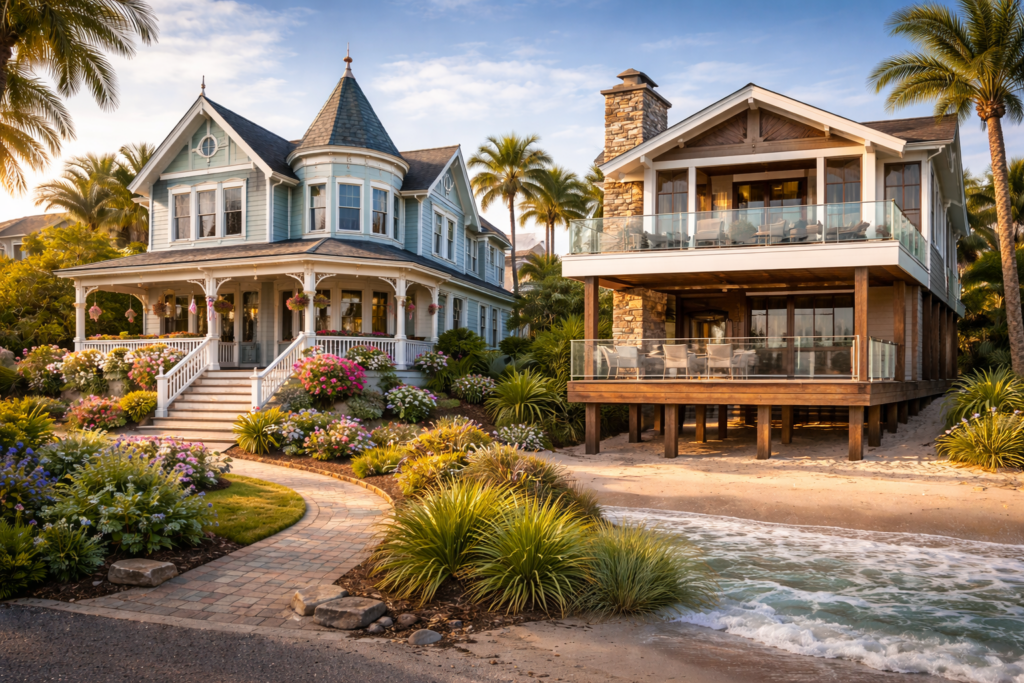
One of the things I say to almost every buyer who reaches out to me is this: Galveston isn’t one real estate market. It’s a collection of them, layered on top of each other, and which one you’re in makes an enormous difference to what you should do and when.
That’s never been truer than this spring. The East End Historic District and the West End are telling two very different stories right now, and if you’re trying to make a real estate decision on this island using the island-wide headlines, you’re working from an incomplete picture.
Here’s what I’m actually seeing.
The Island-Wide Context (Start Here)
Before we get into the neighborhoods, it helps to understand the backdrop.
Galveston is in a buyer’s market. Active listings across the city are elevated — around 1,471 homes — and inventory sits at roughly 19 months of supply, compared to the 4–6 months that defines a balanced market. The city-wide median sale price was $350,000 in February, down about 11.6% from a year ago.
That sounds like one story. But it’s really an average of several very different stories happening at the same time.
The primary force driving that island-wide correction is the short-term rental market. A significant number of investors who bought West End properties at peak valuations for STR income are now selling. That exit pressure is real, and it’s concentrated in specific parts of the island. Meanwhile, the East End Historic District — which was never really an investor market — is barely feeling it.
The East End: Resilience Rooted in Character
The East End Historic District is one of the more interesting real estate stories in coastal Texas right now, and I don’t think it’s getting enough attention.
While the city-wide median dropped 11.6% year-over-year, the East End Historic District’s median sale price in February came in at $478,000 — down less than 1%. That’s not a rounding error. That’s a fundamentally different market dynamic at work.
Why is it holding? The Historic District’s buyer base has always been driven by full-time residents, preservationists, and lifestyle buyers — people who want to live in a Victorian on a specific block of a specific street, not investors underwriting a rental return. That buyer doesn’t disappear when the STR market softens, because they were never there for that reason.
The supply of genuine Victorian architecture in the East End is finite. It cannot be replicated. And that irreplaceability creates a long-run floor under values that purely commodity housing simply doesn’t have.
That said, it’s still a buyer’s market here. Homes are averaging 132 days on the market, and the typical transaction closes about 5–7% below list price. The sellers who are winning are the ones who price from current comps rather than 2022 memory, and who prepare their homes for the insurance conversations buyers are going to have — because with homeowners, windstorm, and flood insurance together running $12,000–$15,000 or more per year on many East End properties, buyers are doing that math before they make an offer.
For buyers, the East End right now is genuinely compelling. The correction has been shallow compared to the rest of the island, but you’re still in a market where you hold leverage and sellers are negotiating. That combination doesn’t last forever.
The West End: A Market Within a Market
The West End is more complex, and more turbulent — and I want to be careful here not to oversimplify it, because this is exactly the kind of situation where a headline number will lead you in the wrong direction.
The broad West End median sale price is down 22.2% year-over-year, sitting around $500,000 in February. That’s a significant correction, and it’s real. But buried inside that number is a story of sharp bifurcation between premium communities and the mid-tier, and those two sub-markets are behaving very differently.
The premium communities are holding ground — and then some.
Pirates Beach is the most striking example: median sale price up 26.3% year-over-year in February, homes selling in an average of 63 days — down dramatically from 107 days the prior year. Pointe West, the master-planned community at the western end of the island, maintains a median list price above $695,000 and low inventory. Laffite’s Cove, Galveston’s premier luxury waterway community, operates almost as its own category — thin transaction volume, but price-per-foot remains strong and the buyer pool is largely insulated from rate sensitivity.
What these communities share: scarce inventory, genuine lifestyle amenities, and buyers who are purchasing a place, not an investment vehicle.
The mid-tier West End is under real pressure.
Terramar Beach averages 188 days on market and carries a sale-to-list ratio that tells you buyers have substantial leverage. Sea Isle, Jamaica Beach (which has more owner-occupant depth and is holding up better), and the broader West End category all reflect the STR correction clearly — investors who counted on rental income to service pandemic-era debt are selling, and they’re selling into a market with plenty of competition.
For sellers in this tier, the honest conversation is about pricing decisively from day one. An overpriced West End listing in 2026 doesn’t slowly drift to market — it accumulates days and stigma and ultimately sells for less than a correctly-priced listing would have from the beginning.
The One Thing Both Markets Have in Common
Whether you’re on the East End or the West End, insurance is now part of the real estate transaction in a way it wasn’t a few years ago.
Galveston homeowners face three layers of required coverage: homeowners insurance averaging $672 a month island-wide, TWIA windstorm coverage (requiring a current WPI-8 Certificate of Compliance), and NFIP flood insurance for most properties. Combined, that’s $5,000 to $15,000 or more per year depending on the property and zone.
I’ve watched deals fall apart in underwriting because buyers discovered insurance costs they hadn’t budgeted for. The sellers I work with who handle this proactively — who have their WPI-8 current, their flood zone documentation ready, and an insurance estimate available from day one — are moving through transactions faster and losing fewer buyers in due diligence. It’s not glamorous advice, but it matters more than almost anything else you can do to prepare a listing right now.
The Spring Window
I’ll say this directly: if you’re thinking about listing on either end of the island, the window is right now.
Late April through mid-May is historically the strongest stretch for coastal Galveston real estate. Lifestyle buyers planning for summer are active and motivated. The weather makes the island look like what people dream about when they dream about Galveston. And for West End properties in particular, every week closer to June 1 shrinks the pool of buyers trying to close before hurricane season.
Once that season gets active — usually late July through September — buyer hesitation climbs and some lenders add documentation requirements. Properties listed in August just don’t get the same attention as properties listed in April.
If you want to talk through what the market looks like for your specific property — whether that’s a Victorian on the East End or a beach property on the West End — I’m happy to have that conversation. No pressure, just an honest look at what the numbers actually mean for your situation.
Reach out whenever you’re ready.
-Reid