

I grew up in Cedar Lawn, which meant the island was my backyard in every way that mattered. Not the beach-vacation version of Galveston that people drive down from Houston to find on a Saturday — the real one. The one where you knew the names of the kids three streets over and the guy behind the counter at the bait shop and the tennis pro at the club, and none of that felt like anything special because that was just Tuesday.
I didn’t fully understand what I had until I left.
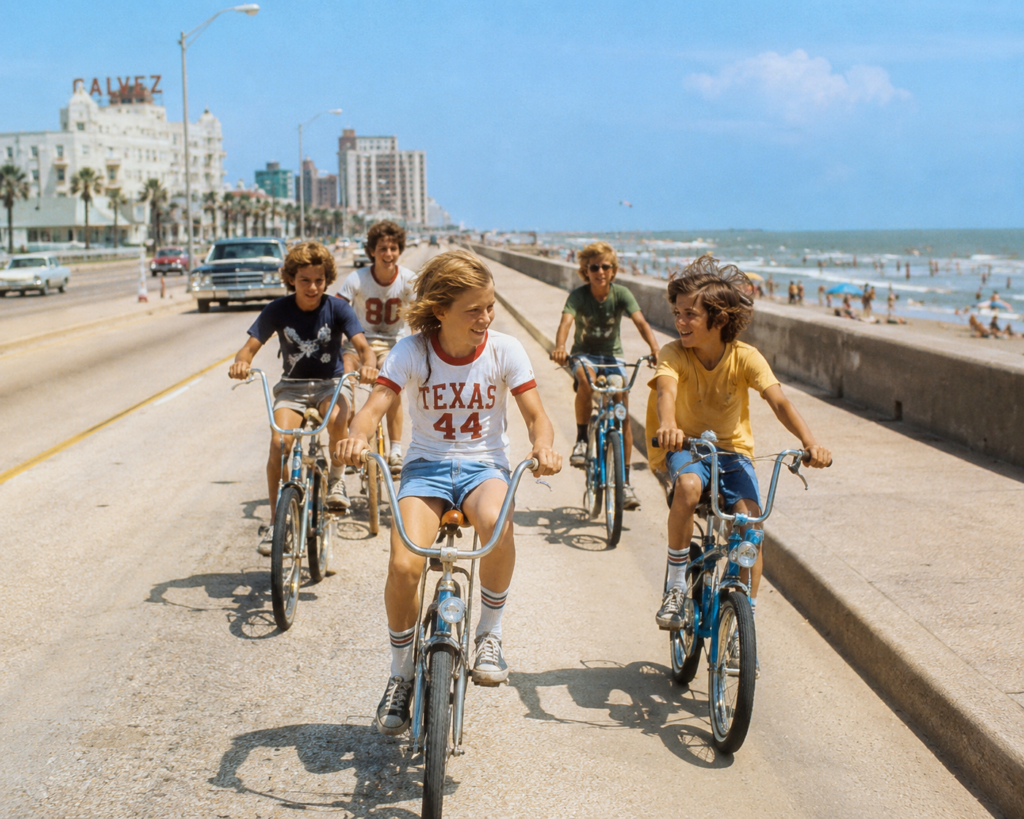
There’s a particular kind of freedom that belongs to a kid on a bike on the Seawall. The sidewalk stretches out in both directions farther than you can see, the Gulf is right there, and there’s nowhere you have to be. We rode it constantly — not as exercise, not as tourism, just because it was there and it was ours. The wind off the water, the pelicans, the smell of salt and sunscreen and the occasional funnel cake from a stand along the way.
Galveston’s Seawall is more than ten miles long. As a kid, that felt infinite. You could ride until you ran out of energy or daylight, whichever came first, and then turn around and ride back. Simple as that.
Growing up here means you have a different relationship with the beach than most people ever get to have. It’s not a destination. It’s not something you plan. It’s just where you go — on a Tuesday afternoon when school lets out early, on a Saturday morning before it gets crowded, on a random July evening because the water is warm and there’s nothing better to do.
I spent more hours on Galveston’s beaches than I could ever count. Not always swimming. Sometimes just out there — watching the waves, digging around in the sand, looking for whatever the tide had brought in. The Gulf of Mexico has a particular quality in the early evening when the light changes and the wind settles a little. Even as a kid, before I had any words for it, I knew it was something.
Galveston has always been a town that takes its golf and tennis seriously, and I grew up around both. The Galveston Country Club was a fixture of island life — not in an exclusive, untouchable way but in the way that community anchors tend to be. You’d run into your neighbor there. Your teacher. The family you’d known since before you could remember.
Tennis was something I played regularly growing up, and golf came with the territory on an island that has always had a strong club culture. What I remember most isn’t any particular game but the way those afternoons felt — unhurried, social, the kind of time that doesn’t have an agenda.
That’s Galveston. Very little felt like it had a hard agenda.
If you grow up on this island and you don’t fish, people tend to wonder about you a little. I fished. The piers, the bay, the surf — there were options, and we used most of them. Fishing here is never just about the fish. It’s about the early morning before everything else starts, the patience of it, the way the water looks at that hour and the way the whole day feels more open when you begin it that way.
There’s something about the bay side of Galveston that I’ve always loved differently than the Gulf side. Quieter. The herons working the shallows. The shrimpers going out in the early morning. It’s a part of the island that visitors don’t always find, and it’s as much a part of what this place is as the Seawall.
This is the part that’s hardest to explain to someone who didn’t grow up here, but it’s probably the most important part.
Galveston is a small town. Not in size — it’s a city of nearly 50,000 people on a 32-mile island — but in the way that matters more than size: the density of connection. You couldn’t go anywhere without running into someone you knew. The grocery store. The gas station. The movie theater on 61st. The diner downtown. Every errand had the possibility of turning into a conversation, and most of them did.
I didn’t think about this as anything remarkable when I was living it. It was just the way things were. You ran into people. You stopped. You talked. Sometimes you were in a hurry and it slowed you down, and you didn’t really mind.
I left Galveston to go to college and then spent twenty years in San Antonio. I loved San Antonio. But I never stopped being from Galveston. And when I came back, one of the first things I noticed — really noticed, the way you notice something when you’ve been away long enough to see it clearly — was that nothing fundamental had changed. You still run into people everywhere you go. The island still has that quality of making strangers into neighbors and neighbors into lifelong friends.
When people ask me why I came back to Galveston to go into real estate, I don’t have a complicated answer. This is where I’m from. I know what it’s like to grow up here, and I know what it offers, not just as a market or an investment but as a place to actually live a life. The bike rides and the fishing and the tennis and the beach and the small-town feeling underneath all of it.
When I’m working with a family thinking about making Galveston home — whether they’re upsizing into a neighborhood where their kids can ride their bikes, or buying a second place on the water, or downsizing into a condo the East End — I can tell them what this island actually feels like from the inside. Because I grew up here. I left. And I came back.
That’s the thing about Galveston. People come home.
If you’re thinking about what life on the island could look like for your family, I’d love to have that conversation. Reach out anytime. reid@reidnelsonrealty.com